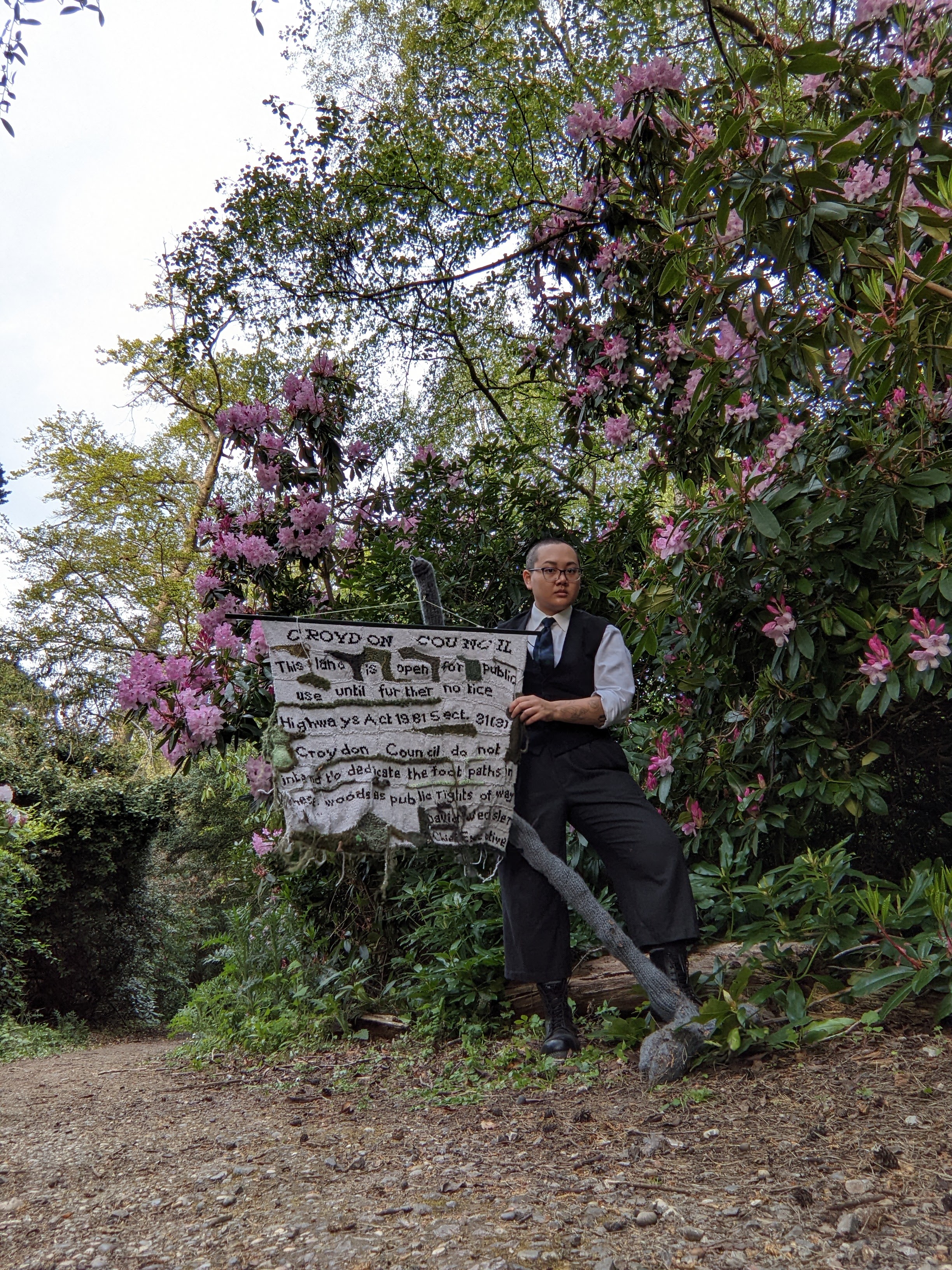
I’m supposed to let my work do the talking. Being professional means playing with perspective, softly blur out my actual opinions in contrast to macro shots of The Work. I’m supposed to get some intellectual distance, zoom out until all knowledge is flattened into those little geometric mazes you get in tube stations—”labyrinthine”, à la Ms. Smith—or nervously describe it as “political”. Vaseline over the lens: just “political”. The content of such politics does not matter, just that it’s political.
I’m supposed to think about my career. That’s the point of having an artist website, to represent my practise to “specialists” and “non-specialists”, which really means “other artists eyeing up the competition” and “non-artists who may purchase my labour”. And so you’re not supposed to write or say anything upsetting or offensive. This is difficult if you are a racialised person (and I could end this sentence right there!) who discusses race and bordering in their work by formulating an informed political position on the subject, rather than letting it sag into generalised notions of “identity”, “heritage”, “belonging”, “memory” and so on.
If you are a racialised person, you need to smooth over any sharpness; your very presence is upsetting, it must be explained, anxieties placated. It occurs to me people have no idea how angry I am. I am curious because of this anger, because I want to know why the world is structured as it is, why it relies on positioning groups closer to death so that the rest, the West, lives in relative comfort. After years of being on the edges of the art world, it seems you’re supposed to confine that any feeling and imagination to The Work while remaining a hollow shell of a person wearing a very small beanie and big work trousers.
Only certain types of practises are considered “professional.” This will never be me, ever, if the only acceptable way of being professional is being an artist ready to be collected. I and my work will never be nicely presented, ready to be acquired and neatly presented in the white space. The opportunities I’ve had so far have really been about my community work and performing certain interventions, for which I do not need institutional validation—and I am so thankful I have this self-knowledge.
 Pear Nuallak