
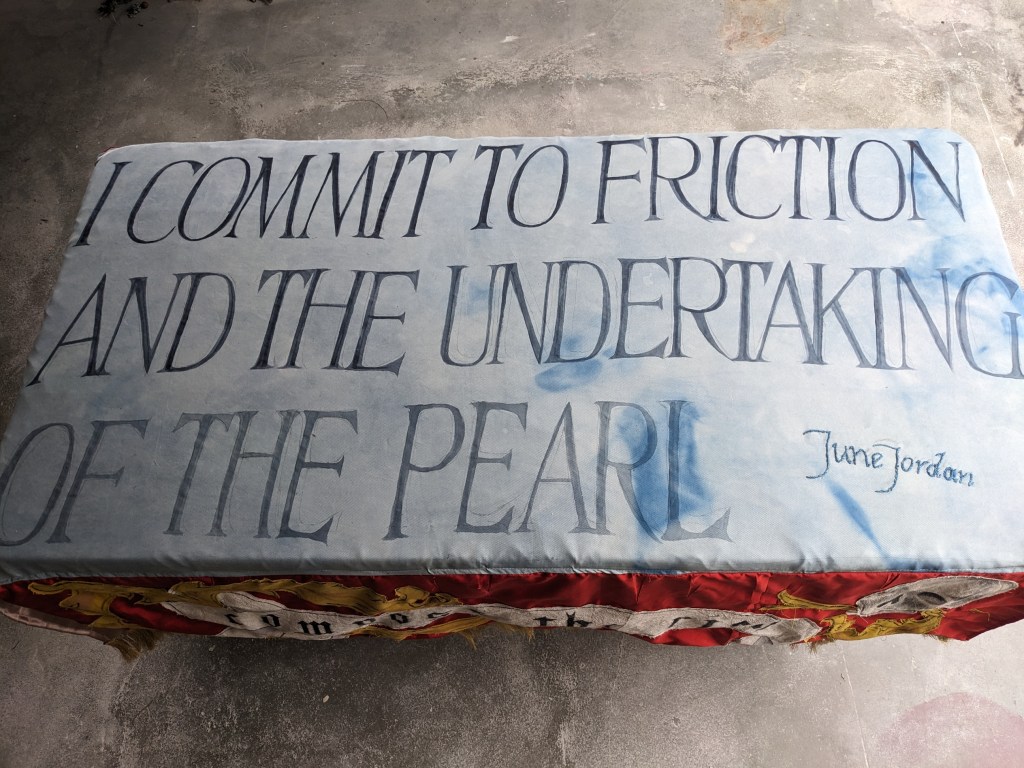
What is left to say? The struggle is protracted. What we do has to proliferate and sustain resistance.

This year, my friends at Remember & Resist collaborated with me to produce two zines. One is our manifesto, the Yellow Peril Self-Awareness Manual. This is our offering to those among our approximate class (intelligentsia, nonprofit workers & students with working class / owner-operator / aspirational parents), who are bored of the mainstream Stop Asian Hate narrative and aesthetic. Maybe you don’t even realise you’re tired of it because this is the only version of things that’s been presented to you.
- Do you feel that you’re never allowed to be angry?
- Have you ever been told you’re both rude and idealistic?
- Are you feeling social pressure to be “nice”, “measured”, “professional” and “objective”?
- Maybe you’re confused by everyone telling the same public backstory of hardworking business ownership or self-employment…
- Annoyed when other Asians talk about how they have feelings too and how they just want to fit in and be accepted? (All this begging and pleading is horrific, isn’t it?)
- Ever felt alienated from the respectability of Stop Asian Hate movement, or the cultural shift towards ESEA joy?
- Maybe it’s because you’re not respectable or joyful, and because you’re not sure how focusing on this version of “ESEA” identity connects to other urgent social movements…
The Yellow Peril Self-Awareness Manual has something for you! Read the free PDF here.
We debuted our zine at the How to Catch a Pig zine fair. Funnily enough, someone who had contributed to the Yellow Peril Awareness Day bought a copy and didn’t seem to think there was any political distinction between any of those things. Indeed, I notice that people tend to categorise things as either “activist stuff” or “cultural stuff.” We hope to activate a deeper sense of discernment in people who are beginning to mobilise.

Our second zine was a re-release of Kay Stephens’ Against ‘Hate Crime‘ with two introductory essays by me and Kirstin.
Are you:
- Worried about your loved ones and your own personal safety, but frustrated by the lack of options?
- Confused by individuals and community services encouraging “non-police” support while also wanting the police to “do something”? What’s going on?
- Working in community services (ESEA or otherwise) and have concerns about how the state interacts with vulnerable groups & individuals?
- Wondering what reporting hate crime actually does, or what police actually do (in general, and with hate crime data)?
- Frustrated with the general state of ESEA discourse?
Against ‘Hate Crime’ provides some answers to these questions, but we also hope it leaves you still curious and eager for something more. Read the free PDF here!
This is part of our long-term project to archive, re-contextualise, and redistribute existing ESEA abolitionist writings. Our theory and documentation of our praxis needs to be easily retrievable as a community resource.
Because representasianism serves bourgeois class interests, hate crime discourse gets a periodic discursive refresh in big media outlets. It seems that every few months some godawful article is curled out by some representasian journalist gnashing their teeth about how ESEAs are ignored by the government because we’re not reporting enough hate crimes. This, along with hate crime data projects and consortiums releasing intermittent reports, is part of their strategy to dominate the discourse and ensure that all community services continue to have meagre state funding under the material and ideological structure of “hate crime prevention.”
We hope that redistributing Kay’s work intervenes in this cycle because it’s concerning that hate crime discourse has become naturalised. We hope this increases criticality and questioning and re-mobilises people–especially in the aftermath of the summer 2024 pogroms when the best help that the hate crime consortium offered was sympathy and data collection. These structures are built to contain and demobilise. The bigger project is to find better ways to sustainably meet community needs and prepare to divest from those structures.
***
Our two zines were due to be sold at the ESEA History Month flagship event in September 2024. We withdrew from the event and returned payment to the organisers due to the sponsorship by ajinomoto. We were grateful to have received this information: while ajinomoto is not on any official BDS boycott list, it has partnered with an israeli company and this is unacceptable to us. We were glad to see the ESEAHM event went ahead without ajinomoto funding.
While besea.n displayed a degree of transparency about what went on, we must point out that in 2024 they went ahead with more than one partnership with credible links to the israeli regime and were unaware of such links until we informed them. Because general ESEA discourse takes its default position as financial opacity, lack of accountability, and nicey-nice conflict aversion that ironically produces reactive situations they so deeply fear, a straightforward disclosure about the situation by besea.n predictably resulted in a huge outpouring of love and support from online commenters for being ever-so brave.
We think this is the best outcome. At the same time, none of this is praise for besea.n or any similar NGO-ised group.
If such an outcome is considered as meeting a praiseworthy standard for being radical and principled, we have so much more work to do. However, any such work will not take place between us and besea.n; we told them in specific terms we only want to collaborate with people who share our values in action and do their due diligence.
We name besea.n simply because this has been our specific experience with them. They are only one among many other groups and individuals who make up the ESEA nonprofit industrial complex. Our problem is not with them in particular but the entire system–in which, as I have tried to point out, I and my comrades are very much implicated because this is the reality of life under capitalism. Lots of us are pink collar workers, influencer-adjacent, or some highly pressurised soul-grating combination of both in our 5 freelance jobs for wage labour. It’s horrible! Much of our daily composition is not that different whether you’re a dayjob-enjoying fintech representasian or dayjob-hating abolitionist supersoldier.
But if we want to get rudely specific, perhaps there is a particularly toxic ecology within this: the unsustainable bourgeois mindpalace. This is where you live, walled up in fear about hate crimes, your reputation, your funder’s reputation and your funder’s funders’ reputation. Your interest in “activist stuff” is wholly in simpatico with your CV. There is a complete identification with you, your dayjob and this “activist stuff.” And when you look up from updating LinkedIn, what is the horizon of freedom that you see from your windows? Nicer police and more Asian managers.
Because we ultimately want different things, we’re not interested in being annexed by the bourgeois mindpalace. We don’t especially want to make huge efforts in representasian political education or emotional growth; hold space for them; “call them in”; or otherwise prioritise investing emotional or material energy in NGOs or NGO-brained individuals in a way that meets their desire for gentleness. Doing so merely contributes to their rebranding and optimisation strategies. Why do this when we could be learning with, from, and through the masses?
But we’re also not going to commit the majority of our effort to “calling out” specific groups and individuals. To whom are representasians actually accountable? We certainly don’t want to take that up. A beef is just that: beef. It’s not strategic thinking. The end goal is not the personal humiliation of representasians but the increased mobilisation of our communities against violence and neglect in the core, building solidarity with all colonised peoples of the world. Popularising abolitionist ideas means we have to actually develop effective messaging and a viable short-to-medium-term social program that is better than the crumbs currently being offered to the community. (We know abolitionists working within these services are struggling to do all this and more, and we send all love and solidarity.)
Lastly, I am a proponent of productive conflict but recognise it is a resource heavy process. It’s also vital not to demotivate people or sink into petty sniping–while I take responsibility for naming certain groups in my writing, I try to place them in context by historicising them and primarily criticising systems of domination and unhelpful ways of thinking. I accept the numerous personal and professional consequences of this. I see people burning up with resentment but do not know what to do with that intense information in their bodies: if you think the movement would benefit from individual exposure and interpersonal conflict, by all means take up that struggle and shoulder personal responsibility for these resource-intensive moves. Do not outsource this to me or my comrades. We consider this specific matter with the named organisation to be resolved and are disinterested in further involvement.
***
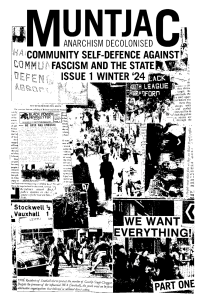
Because I believe in coalitional struggle, I want to draw your attention to Muntjac! Covering different areas of community self-defence and wielding everything from analysis to poetry, you’ll be relieved and excited to find an anarchist tendency which has racialised peoples of the world as its starting point. Read the first issue here.
***
In terms of contributing to “british” ESEA discourse in 2025, expect more work on hate crime data reporting. We hope to share at least one more piece of writing next year as well as working out consistent distribution of our physical zines. We also look forward to starting conversations with abolitionist ESEAs who work in community and migrant services on creating resources. In the meantime, we continue to struggle against colonisers on domestic and international fronts. Support the survival of Palestinians and the work of Palestine Action.
Edit 2 Jan 2025 for typos and phrasing.
 Pear Nuallak