Are you a representasian?
Is your mum a representasian?
Can a small business be representasian?
The UK response to post–2019 street violence against Asians coalesced around #StopESEAHate. This movement did not originate from anti-raids networks, migrant support groups, anti-fascist or abolitionist groups who arm themselves with the knowledge that street racism is the breeding ground for fascism and a bottom-up demand for more state violence, and so act accordingly through street defense, mutual aid and political education. Rather, #StopESEAhate gradually gained momentum in the public eye through hashtags, a 2020 parliamentary debate, and a spate of 2021 articles in places like Vogue, Vice, and Harpers Bazaar. The Stop AAPI Hate campaign came from the US media class; this too was the case in the UK, with ESEA celebrities joining hands with NGOs to collect funds “for the community.” This established the co-ordination between ESEA politicians, celebrities, influencers, charitably-minded corporate workers, academics, art and theatre workers, writers, journalists, paid and voluntary workers for community centres and migrant services, and other ESEA-themed nonprofits. This co-ordination continues to this day and is animated by the same approach: representasianism.
Representasianism is a way of looking at the world which reduces all social problems affecting Asians living in the West into one key tenet: bad representation. The solution to all of these social problems, including street violence, is therefore more representation. This Asian branded version of liberal representational politics calibrates complex issues like a series of knobs: more Asian, less Asian, better Asian. (Worse Asian is not an option.)
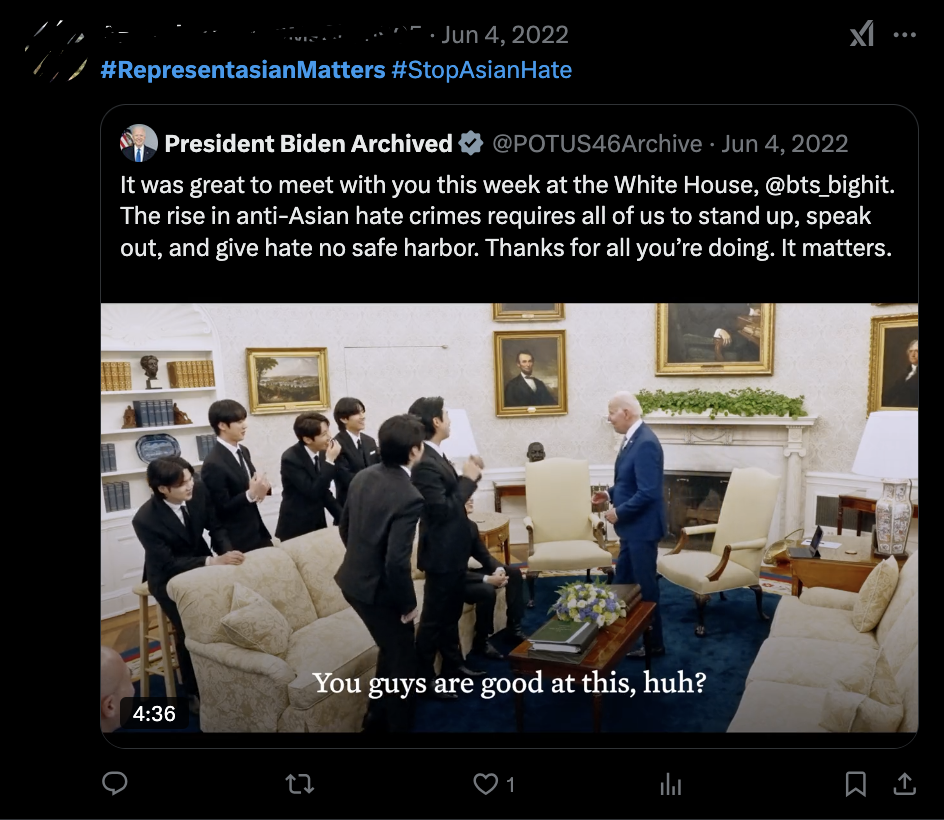
I did not coin the word ‘representasian’ – I mockingly took it from the twitter hashtag #representasianmatters and put it into my book as something mildly funny that would stick in people’s minds. So while this isn’t really a serious explanatory framework meant to do heavy theoretical lifting, I still think it can be useful as a starting point for tackling the current dominant framework in ESEA discourse.
Because of the co-ordination between various nonprofits and the media class, it’s insufficient to characterise representasianism as merely the work of particularly dim liberal influencers who whine about Asian roles in movies. It isn’t even adequate to identify its most egregious realisation in one-off events like self-organised domestic workers going to Buckingham palace to shake hands with the coloniser-in-chief(!). Representasianism is a realisation of imperialist entitlement. Its primary grievance is racial misrecognition and proposes increased state violence through legislative responses and policing as correctives. Representasianism clothes this entitlement in feelings, relations, & concepts like “innocence”, “care”, “joy”, “unity”, and “community” to avoid reckoning with how ESEA group identity has its own differentiated and at times fundamentally conflicting needs. Rather, ESEAs are encouraged to realise themselves in terms of a viable market identity that can consume, compete, and proffer targeted services, generating its own economy. Above all, representasianism tethers all our identity to the maintenance of the state, undermining genuine solidaristic grassroots organising and potential for insurgency.
It’s with this in mind that I created a mnemonic for what I believe are key components of representasianism: FRIED RICE.
Fear
Reformism
Image
Exceptionalism
Deference
Respectability
Innocence
Counterinsurgence
Entanglement
This mnemonic attempts to bring out how this is not a problem of mere disagreement of tactics or even, god forbid, a unified movement with a moderate and radical wing. One side is invested in the destruction of the white supremacist colonial project while the other desires acceptance and progression within it. We don’t want the same world.
***
Fear
The governing emotion of representasianism is fear. The middle class #StopAsianHate influencers fear being “cancelled,” they’re scared for their reputations, they’re frightened about their little projects not going well. They are genuinely concerned about their vulnerable elders, and can perhaps spare a thought for working class Asians in public-facing roles who are hypervisible targets.
Fear is invoked through the figure of a racist boogeyman who will hate crime anyone on the street, even if you’re respectable-looking and fully assimilated. Fear of immigration raids and other forms of state violence which target the most vulnerablised populations is simply not legible to representasians. Similarly, the daily immiseration of homelessness, exploitation, and debt are not treated as existential threats. This obscures the relationship between street racism and state violence as well as class-differentiated experiences of violence. All of this is outside of the “hate crime” framework by design, so it’s neither mentioned in articles handwringing for more action against hate crime and nor held as a point of contradiction by migrant services who support people at the sharp end of violence. Representasianism forces a link between this fear and a desire for more acceptance into the existing social order, all while obscuring the root causes of this attack and neglect: the state and capital.
How we’re allowed to relate to others and ourselves as “ESEA” is shaped by fear. What’s offered by and for self-identified ESEAs in terms of online and IRL community spaces, supper clubs, cultural events, workshops, art, film, books and so on encourage a certain type of participation. Most of these spaces invite people into a positive relationship structured by recognition, joy, healing, safety, food, and a feeling of home. Everyone is “nice” and makes the same jokes about cut fruit and trauma and dimsum on Sundays. #IYKYK suffuses everything. If the corrective to street racism is only allowed to be a highly specific vision of safety, this creates a reductive ESEA identity that is always in need of a hug and affirmation through state rescue.
Reformism
For the representasian, it’s simple: the basic system must stay the same. They don’t want to burn down white colonial institutions and build a new world in the shell of the new – in fact, they actively desire the integrity of the whole thing so they can line up at the door for job interviews, respectfully queuing for a seat at the table. The horizon of change is therefore increasing representasian and participation within these structures, contributing positively to immiseration, scarcity, and incarceration through a little charity work. The logic goes like this: Asian faces in high places is a sign of social change, so for social change to happen, there needs to be Asian faces in high places. Top down change!
For those closer to the ground in the migrant sector, frontline staff are making certain interventions but are confined by (and perhaps exhausted into) the reformism maintained by senior staff with IR degrees and NGO management backgrounds. In addition to this, conditions for everyone are so poor that the migrant sector becomes a site of “resistance” against the violence of the Hostile Environment. While I’m sympathetic both to this position and to the workers, it’s still important to distinguish between vital crisis management and liberation movements. Resistance does not seek state compliance or less intervention from the state as its ultimate goal but the transformation of reality. While the work of these frontline services is crucial, eliding the third sector with “resistance” forecloses the possibility of a truly autonomous, forceful, uncompromising rebellion against the state–especially considering this is already present in the form of anti-raids networks.

Image
An obsession with image is the hallmark of representasianism because racism is theorised as a form of racial misrecognition: “You’re mistaking me for a nanny, a sex worker, a disease carrier.” Image management is re-cast as liberation (“resisting stereotypes”). Representasians don’t like looking bad; that’s why reformism offers seductive prestige: representasians want to say they’ve “always contributed to this country” i.e. were always a part of administrating, feeding, and nurturing the colonial system. But representasianism tries to have its cake and eat it by saying they’ve always also fought back (Yellow Peril for Black Power!), refiguring insurgence against white supremacist capital as “civil rights” that ensures a more capacious capitalism.
Representasians are obsessed with not only their self-image, but imaging: visuality, presence, depiction. They hunger for more Asian faces on western TV, film and stage; they yearn to be imaged and perceived like this, wishing to capture attention and therefore value. By and large representasians lack capacity to actually use this material to make meaningful or even vaguely interesting interventions – they understand representation only in moral and mimetic terms: We are real people (likeable, hardworking, property-owning citizens), unlike those pathetic stereotypes (orientalised lumpens) on the screen! This fixation on image is so powerful it destroys any genuine worker solidarity in order to naturalise aspirational values. It also usually results in shit art because of the shallow emotional range and curtailed respectable desires.

Exceptionalism
Representasians use the catchphrase Not Your Model Minority to insist on the utterly unique racialisation of Asians, that nobody else has ever experienced hate crimes like us, that we’re so ignored and above all so very invisible–and the in-fighting doesn’t help. Their unspoken resentment presumes other, more unified groups get the lion’s share of attention while fragmented Asians are pushed aside. Make no mistake, “other groups” usually means Black people, flattening Black abolitionist insurgency and the counterinsurgent Black bourgeoisie into the same movement. Rather than looking at complex intimacies and entanglements by historicising settler colonial labour across four continents, racial subjection is entirely reduced to two self-interested “races” competing for resources as if this were a natural phenomenon. This approach presumes the white supremacist state retains control over said attention and resources, so “solidarity” is warped into resolving individual anti-Asian or anti-Black feelings throughout society by increased police action against “hate.”
As Dylan Rodríguez points out, what this framework desires is a compartmentalisation of anti-Asian violence into individual “hateful” acts that deviate from the script of a supposedly tolerant society. This obscures the reality of anti-Asian violence being completely consistent within a society that is generally maintained through the violences of domestic and international warfare, expansionism, and resource extraction.
Deference
Top-down change is the ultimate goal of representasianism. For them, activism is a politics of supplication: endless appeals to the government, the police and policymakers. Data is the language of deferential politics, so representasians prioritise the attention economy and have a consistent strategy for managing the media circus – splashy headlines about soaring crime with juicy statistics. This isn’t a pragmatic approach that targets specific resources but a vague desire for the state to “do more”, make “important decisions” and “key changes.”
Considered charitably, deference can be seen as a survival strategy. You identify where the power is and fall in line even if all you get is meagre scrapings. This is exactly how the desire for social mobility is naturalised in ESEA narratives. Because everyone is flattened into an aspirational hardworking migrant, class differentiation is poorly discussed. There is a wholesale belief in the idea that going up the chain is only ever for the good; those with power are just a little misinformed, so the parvenu can shoulder their humble truths up the social ladder.
Deference takes an especially disturbing turn when people follow the breadcrumb trail to uncomfortable parasociality or celebrity worship of colonisers and génocidaires. An egregious example is how every Lunar New Year, a select few ESEAs put on their little outfits and go to Buckingham Palace or Downing street to “be celebrated”. The main character storyline goes thusly: invitation to the centre of power must mean you’re important enough to “raise awareness” over canapés. It doesn’t matter that the same man whose hand you’re shaking is violently hardening Britain’s borders: what matters is that he is welcoming you. Deference means looking up at the throne so you don’t have to notice whose bones crunch beneath your feet. God’s in his heaven— All’s right with the world!
Respectability
How often have you heard liberal Asians whinge, ‘We’re not X, we’re Y‘? This corrective to racial misrecognition ensures respectable distance is maintained between service and white collar work and criminalised and non-criminalised groups. Resources remain focused on the upper segment of ESEAs: those with imperialist citizenship and settled status who are often highly educated & fluent English speakers with aspirational values, convinced of the morally uplifting quality of their work.
Asian sex workers are violently ejected from this discourse. Middle class cis Asian women resent being “mistaken” for ladyboys or sex workers because of their own transmisogyny, whorephobia and classism: learning from Thai sex worker organising and queer feminist struggles in the pro-democracy movement is of no interest. Even left feminist ESEAs who correctly analyse the sex trade as a direct creation of US imperialism favour “anti-trafficking” organisations as the solution – the arm of US imperialism in its missionary form. In trying to discuss the 2021 killings in Atlanta, ESEA civilians treat sex workers as unspeakable: an obstacle to write around until they circumnavigate safely back to dreary middle class existence, fleeing from curiosity about sex worker organising and intellectual work. As Red Canary Song and Survived & Punished wrote in their statement at the time, it isn’t possible to separate general racialised sexual violence from the layered material conditions faced by both massage and sex workers. The cost of maintaining respectability is the destruction of solidarity, precluding resistance through worker autonomy.
Innocence
In ‘Against Innocence’, Jackie Wang writes, ‘An empathetic structure of feeling based on appeals to innocence has come to ground contemporary anti-racist politics […] Social, cultural, and political recognition only happens when a person is thoroughly whitewashed, neutralized, and made unthreatening.’ Wang is writing about discourses around Black victims of state violence, but there’s clear resonance with current Asian anti-racist organising – especially when triangulated against Blackness. Cathy Park Hong’s Minor Feelings wrestles with innocence, peering into the hideous, shameful crevices of Asian American interiority–but as Hong doesn’t (IMO) write with liberatory intent, representasians merely feel “seen” by her writing. Contrast that with Setsu Shigematsu explicitly naming “innocence” as a sensibility that promotes Asian American imperialist entitlement to protection from public discourse and the criminal legal system. Shigematsu encourages us to realise our deep obligation to the wider political landscape: ‘The sky is not falling on only Asian Americans so let’s not act like Chicken Little. Systemic racism rooted in antiblackness and Indigenous genocide is the blood soaked ground on which we live.’
British ESEA exceptionalism creates an inability to acknowledge shared histories that generate this same feeling of imperial entitlement. When ESEAs try to offer their version of “solidarity”, they’re limited to recognising other people’s innocence rather than analysing and agitating against our shared conditions.
Demanding a framework of innocence at all costs means we do not address abuses of power at any level. The idea that people have irreconcilable interests due to this power is rendered impossible. Once it’s explained that we have to accept our parents behaved abusively towards us solely because of their own trauma, we don’t have to think about the powerlessness of children. When we’re told that shopkeepers have it hard too, we don’t think about what it means when employees have their wages stolen or see the shop as resource-hoarding in impoverished communities. Innocence even tries to whiten the “complexity” and “nuance” we’re told to display by rendering interlocking harms as misrecognition of equally valid suffering.
Counterinsurgence
Dylan Rodriguez describes counterinsurgency as:
… the full spectrum of pacification, isolation, and domestication strategies that extend beyond violent state repression. What i’m calling the contemporary liberal/progressive counterinsurgency is a loosely coordinated bloc that consists of large philanthropic foundations, liberal think tanks, academics, elected officials, media pundits, nonprofit organizations, celebrity activists, and social media influencers, among others.
From its earliest moments, the Stop ESEA Hate movement was counterinsurgent. The will to change was harnessed to call for more state action on “hate crime” as the ESEA cause célèbre. As the state does not want to give resources to marginalised groups, it can feel like resistance to demand the state fulfil basic legal obligations. This is true at the same time as the state actively desiring social control to manage its labour pool. Criminal legal responses, increased policing powers, and “non-police” counselling services designed to capture data for sustaining such criminal legal solutions are all focused on increasing state power, rather than strengthening the autonomy of migrants and other vulnerablised populations.
Instead of challenging this, broad swathes of the Stop ESEA Hate movement enthusiastically took up administration of these placatory measures. This is particularly concerning when we consider the On Your Side hate crime hotline was initially funded through the British Nationals (Overseas) welcome programme during post-BLM public conversations on abolition and police brutality. With such a big publicity push during a time of crisis, it’s understandable many people joined in–doing something seemed better than doing nothing at all. There was this hopeful feeling that as long as you could get along with others to achieve a goal, your particular cause might benefit and could even trickle back into more radical politics, like the impossible physics of an M.C. Escher drawing. And that’s exactly how this type of counterinsurgency works: you don’t even realise you’ve already given up the possibility of tension.

Entanglement
Previously, I thought the representasians who theorise violence as microaggressions and demand more media visibility should be blamed for stealing air from frontline migrant support services doing vital casework, advocacy, and organising against state violence. There seemed to be a clear split between the media class / white collar workers doing ESEA advocacy as voluntary DEI / community work VS. charity workers and movement organisers. I still think this is broadly true, but from conversations between comrades, reading on counterinsurgency, and reflecting on our brief movement history, it’s clear there’s always been overlap and some form of co-ordination between these different sections (just as with every other social movement!).
Frontline services and academic researchers need a way for their messaging and knowledge-making to escape the confines of their fields and access broader public attention. Ensuring a positive relationship between ESEA public figures – big name actors, writers, or influencers &c – secures their share of not only donations but the discourse. These figures might give shout-outs on social media and in public appearances, or maybe they’ll speak at events, blurb each others’ books, sign letters and petitions and so on. It is an exchange of social capital. As I mentioned in the introduction, this was in place from the beginning of #StopESEAHate – Asian celebs and media-types promoted the fundraiser, ensuring that cash, attention, and therefore legitimacy were injected at a pivotal moment.
There’s also the social factor. The representasians are all in their little cliques; they’re friends-of-friends-of-friends for the rest of us. Perhaps you were the only Asians in your workplace, hobby, or organising group. Maybe you all went to Oxbridge or the same private school. Possibly you’re in one of several big Asian groupchats. You were drawn together in an intense moment of both crisis and comfort, and now it’s rather awkward because your friends, acquaintances, colleagues and clients are deeply involved in projects and organisations that you know are harmful or at the very least rather cringe. It can be difficult to know what to do next. You fear upsetting people, alienating them because you’re being difficult–or even losing your ability to support other people or keep a roof over your own head. You feel that whatever you do, it’s just not enough.
***
We need to consider who we’re abandoning when we worry so much about what people think of us. In the past few years, we’ve seen what can only be described as an assimilation speedrun: various co-ordinations between different ESEA groups have constructed exactly what they think a “mass movement” needs: a hashtag; slogans at rallies with charismatic leaders; social capital transferred into a hate crime hotline, rebranded community centres, some exhibitions, a handful of trade books. Some of us bask in public life while the rest struggle in the fight against borders, homelessness, exploitation, debt and early graves.
The answer to what to do is sometimes more complex than what I’ve previously proposed. Now, I’m not going soft on you: I still believe there are situations where refusal is the only ethical option. If your body is telling you that you need to leave, listen. As regards people insisting we should stay and “change things from the inside”, the standard has been set by the 1972 overthrow of the Institute of Race Relations by its own staff, including A. Sivanandan, which transformed it utterly from a well-funded imperialist thinktank to the radical publication we cherish today. People are never moving like that: when they insist they’re a force of change from within, they want big sponsorships and investments and promotions from the same old genocidal climate-destroying companies, but it’s radical because they offer that money to grassroots radical groups and put on community events, making us all beholden to these wretched entities.
I propose a consideration of your personal relationships as critical connections that could create social change. I don’t mean the formation of yet more academic abolitionist cliques and I don’t mean that hanging out with your little friends is “organising” in itself. Not all of us can or should be friends, but we can still be connected and have certain obligations to one another. If we notice conflict-avoidant patterns of behaviour, it’s worth calling on each other to be brave and actively invite criticality. Consider introducing and maintaining some form of tension. The energy in a room changes immediately when people commence from a radical starting point: remember this is an option, too. And understand that we can do all this in an actively caring way without the politesse, deference, and respectability that we’ve been encouraged to think of as professional, and how this professionalised persona is called into managing situations to neutralise change. High-conflict, criticism-only cultures are a different cheek of the same arse, a different branding on maintaining hierarchy that necessitates disposability. This political moment demands different ways of relating to one another.
The fetishisation of ESEA “community” relies on a complete removal of tension. Even the mildest state-sanctioned protest is too aggressive for some people; they favour bringing people together over food because this is true community connection as it exists right now. This is placed in opposition to the poor souls who shout unattractively in public because they do not like the world as it exists right now. Untethering care and feeding from acts of resistance while calling this “grassroots activism” is a rebrand of social enterprise. Not all of us can physically engage in insurrection, but at the very least we should understand blockades, encampments, and occupations as sites that require food and care to maintain their resistance. Rather than disavowing feelings of revolutionary anger, turning away from the streets, and abandoning those criminalised by the state, we need to be actively nourishing our movements so we can continue to not only mobilise but escalate our insurgency.
Some questions to ask ourselves:
Fear – Can we create a rich culture of bravery–feeling the fear and doing it anyway–that supports active engagement in liberation movements?
Reformism – What will this actually, specifically, genuinely change in the short / medium / long-term?
Image – How can I break out of the limited ways I want to be recognised?
Exceptionalism – What do we have in common with local and global liberation movements and how does this inform our deep obligation to them?
Deference – Are you happily slotting into existing hierarchies or are you meaningfully working towards redistributing your own power for all?
Respectability – If I release the desire for prestige and status, who would I be and who else would I turn towards instead?
Innocence – What can be revealed if we refuse to emphasize innocence and accept everyone’s capacity for harm and violence?
Counterinsurgence – What is being offered to placate us and prevent our collective energy from bursting forth?
Entanglement – Which of your relationships needs more tension, and which of them need more care?


One response to “2. Representasianism 101: What is FRIED RICE?”
[…] Representasian 101: What is FRIED RICE? […]
LikeLike