NOTE:
This is a piece of writing from 4 years ago that was first published in Abolitionist Approaches to Hate Crime by Remember & Resist. I remember being very nervous when they asked me to write something because I didn’t really come from an organising background: all I did was co-run a small queer community hub that was intended to bridge the gap between morning and night shelters, open to any queer people who wanted to come in from the cold and eat snacks, charge their phone, and hang out. It seemed to me that Remember & Resist were doing bolder things that I was too scared to do; I didn’t feel ready to contribute to their knowledge but I still wanted to step up into the role of being their comrade. Maybe they recognised that the work of building connections against abandonment was something we both shared. I wish to share that background to make it really clear that you have to be very intentional and active in connecting your community work to liberation, otherwise it’s just charity.
My comrades made the decision to publish it completely unedited, so I’ve done the same here. I hope that this shows how much I’ve grown in terms of writing. The zine made it very clear that some of us were thinking really differently from the early days of “Stop ESEA Hate.” Next time someone in your community says we ESEAs are still figuring out who we are and what to do because we’re so invisible, I hope you feel encouraged to introduce them to our work.
***
DEAR YELLOW PEOPLE,
It is with love that I tell you I really don’t like how a lot of us talk about race.
If I read another article about how we need “better representation” to “resist stereotypes”, “combat bias” and improve our communities through “data-driven policy”, then I will simply lie face-down and scream incoherently through the floorboards.
I acknowledge this seems like an outrageous response to the current crisis – shouldn’t we welcome neat solutions to the problems within our community? And why is it so stressful to read the outpouring of personal stories appended by hashtags, especially as so many of these mirror my own?
I feel exposed without truly being seen. It feels that this outpouring is not for or with me, but it is to try to get white people to believe that we are people–I am a person, too.
The positioning is all wrong. Putting white personhood at the centre annoys me; I want space for rage that isn’t immediately channelled into directing white people to behave better. I want anger that is my own and it makes me feel itchy when I see attempt after attempt to Dear White People our way to liberation.
But I know that if I also write from a place of contempt for our communities, it will not open things up for us. We become defensive and confused if we’re scolded – our political imagination does not flourish under shame. It also never feels like quite the right time for critical thought: something is always happening to us, and I do think we need soothing balms rather than hot takes. And yet here I am, irritated and discomfited by many of these rousing calls to action. I don’t want to tell white people how to “break down stereotypes” and teach them about an “authentic Asian experience” by telling them all about intergenerational migrant trauma: I simply want to eat a bag of crisps and cry.
What follows is my attempt to make a little room for the frustrating contradictions at every level of our lives. I will use a mix of “I”, “us”, and “we” throughout, to break down the binary of Good Take vs Bad Take, Scolding Auntie vs The Scolded, because I am enmeshed within this too.
***
I wish to apologise for the usage of “yellow,” an ugly racial epithet, and then immediately retract that apology.
Let us be honest with ourselves. In the uprisings in the summer of 2020, many of us non-Black Asians likely shared an image that proclaimed YELLOW PERIL FOR BLACK POWER. We saw the shared histories; we wanted to understand ourselves in coalition with the struggle for Black liberation (even though it was kind of performative).
Fast forward to 2021, and suddenly we’re not so sure. “Guys, it’s racist to call us yellow,” we tweet, “I mean, we’re not actually yellow? Some of us are tan! This is brown Asian erasure. It’s not a very inclusive term…”
I would like us to understand that, historically, the very function of racial nomenclature is to obsessively sort and place people within racial hierarchy, assessing the cognitive and physical ability of each “race” through the gaze of the scientist / overseer and linking that information with our capacity for labour. In this way, we can see how the labouring class is racialised and how the creation of race is closely linked to that of disability, and so on.
Knowing this, what does it mean to organize for liberation under racial colour names? By taking on this identification, we name what white supremacy has done to us as an oppressed class. In her research on Black queer community spaces, historian Sue Lemos observes that in the 1980s, political Blackness was not about describing physical attributes or even a particular ethnic origin, but was a means to identify yourself as part of an international anti-imperialist coalition–much like how BIPoC is used now. By bringing this up, I do not propose a return to how we identified and organised ourselves under Thatcherism; rather, I want to emphasize how the focus should be on our current material realities and political goals, rather than using racial colour names like MAC foundation swatches.
I can’t tell you how and when to use “yellow” because I myself am not sure. I can say that I am not very interested in delineating who exactly can identify as “brown” or “yellow” as if it’s a special club; we will have to account for that ourselves depending on our current positioning and concomitant political goals.
***
NEOLIBERALISM HAS KILLED OUR IMAGINATIONS.
What does it mean when the tools of a racist patriarchy are used to examine the fruits of that same patriarchy? It means that only the most narrow parameters of change are possible and allowable.
Audre Lorde. “The Master’s Tools Will Never Dismantle the Master’s House.” 1984.
Every time we’re in the news, usually when we have been attacked or killed by agents of the white supremacist state, our feeds are filled with stories and solutions. We are urged to participate in something called “representation,” as the harm inflicted on us is assumed to be related to how we are over-, under-, or not at all represented in various places, e.g. the media, hate crime statistics, and the bureaucratic class.
We become convinced that Good RepresentAsian (sorry) is how we finally get taken seriously. Good RepresentAsians speak prestige dialect English, are highly educated, and do not perform service labour, thank you. Good RepresentAsians are of course Hard Working Asians or have them as parents. Good RepresentAsians can reframe the complex intergenerational legacies of colonialism as individual trauma narratives, rather than ongoing structural forces with highly material consequences. (I myself wrote a piece for The Toast called Grandmother’s Misplaced Recipe for Cultural Authenticity.)
Good RepresentAsians also offer a rich spread of data to persuade us into trusting the police and reporting hate crime in order to achieve equality, as reporting white supremacist attacks to a military arm of said white supremacist state is how our communities can effectively combat this brutalisation. Once the numbers are totted up, once we have a bigger share of the attention economy, we hope that we will then see material benefit.
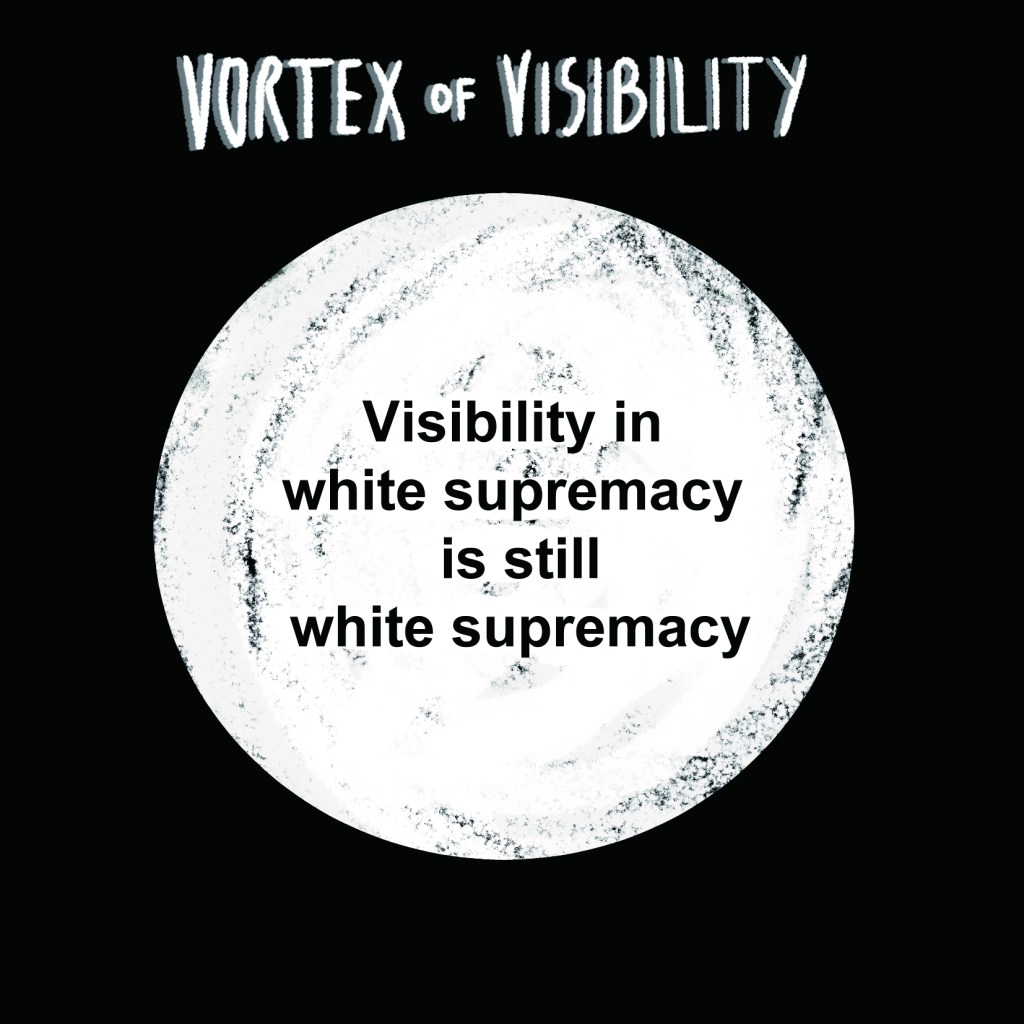
The encouragement to work with cops is part of the oft-repeated narrative that “Asian-hate” is “finally” being taken seriously, that Asians are now visible. We simplistically compare the invisibility of our struggles against the hypervisibility of Black people. This is classic racial triangulation that positions [non-Black] Asians as competing against Black communities for… what, exactly? All this, as philosopher Olúfẹ́mi O. Táíwò observes, is based on a fantasy about the relationship between the attention and material economy; Táíwò describes it as “racial Reaganomics.” In other words, Good RepresentAsian relies on the dubious idea that it all eventually trickles down.
***
***
ARE ASIANS ACTUALLY INVISIBLE OR ARE WE JUST CLASSIST?
… popular culture, commodified and stereotyped as it often is, is not at all, as we sometimes think of it, the arena where we find who we really are, the truth of our experience. It is an arena that is profoundly mythic. It is a theater of popular desires, a theatre of popular fantasies. It is where we discover and play with the identifications of ourselves, where we are imagined, where we are represented, not only to the audiences out there who do not get the message, but to ourselves for the first time.
Stuart Hall. “What is this ‘Black’ in Black popular culture?” 1992.
Let’s look again at the idea of invisibility vs visibility. Probably some of us have said, at some point, that Asians are “unseen”, “invisible”, and “lack positive representation” – and then go on to name all the ways in which Asians are seen, such as working in Asian restaurants and grocery stores, as cleaners, care professionals, massage workers and sex workers. We are simultaneously not seen at all and seen too much.
We point to how Asians are frequently represented in the media as robotic labourers, as a foreign mass, de-sexed or hyper-sexed; tragic figures that must die to advance the plot or figures that are not even alive enough to properly die. This angers us, and we often position the media representation of Asians as a significant reason for white supremacists targeting us. We want to peel back the lies and reveal the real human beings. We often want to talk about how we’re actually good and hardworking, how we’re actually part of the managerial class, what our authentic ethnicities and cultures actually are, in order to prove we’re not like those Asians.
What if some of us are those Asians? Do we not deserve liberation?
Why should we ask white people to see us properly when we refuse to even see ourselves?
If being correctly visible actually worked as a conduit for delivering justice and resources, wouldn’t it have worked by now for various communities?
We should consider the relationship between Asian migrant workers and imperialism and how the white colonial state defined citizenship in terms of racial belonging. In the first chapter of Ornamentalism, ‘Borders and Embroidery’, Anne Anlin Cheng discusses how the figure of the Asian woman has been both lewd and alien, and how those qualities are very literally fabricated: Asian women are racialised through the weaving of wild fantasies into a sartorial surface, not objectified but simply object. There is no real human being under the peeling of this racialised layer. The white supremacist state defines its respectable white citizens in opposition to us by not even admitting us as human in the sense of both border control and in its realisation of personhood.
To those of us that are civilians: rather than finding it demeaning that Asian women are presumed to be sex workers and attempting to distance ourselves from erotic labour, we need to understand that an injury to one is an injury to us all. The solution, here, is not to agitate for more Asians to become bosses or to support Asian capitalists rather than white ones, but to stand with all workers and understand how policing and criminalisation harms every single one of us.
Can we imagine a shared trajectory that is not assimilationist?
What could help us dream?
X
Lately I’ve been thinking of harm as intersecting points on two different timelines. Harm is here: X.
There were things that came before the harm and there will be things that continue afterward.
It is important to ask how we got to this point without diminishing the violence or flattening the impact. It’s not I am a person too but I am a person and you are a person. This is harm and this is harm. It is only then that we can begin to understand and meet people’s needs.
At the meeting-point of timelines, we see the eruption of physical attacks against vulnerable members of our community. Images of Asians being brutally attacked by non-Asians are circulated on social media; we feel pain and fear and uncertainty. Perhaps somewhere in our first thoughts are: I hope whoever did it was caught. I hope they are put away forever.
Our anger at such violence, our feelings of vengeance, are things to feel our way through as we re-examine what justice is. They should not motivate us to actively encourage surveillance, policing, and incarceration.
Hate crime creates its own logic of criminality. The way that stories and videos of violence and harassment against Asians are circulated in social and mainstream media encourage us to see harm through this lens, especially when accompanied by language that calls for bringing perpetrators to justice and encouraging people to report hate crimes. We see this ugly, raw violence all over our feeds; we want someone to fix it, to see the suffering and take it seriously. Something must be done! We are taught to think that the authorities are the ones who can address that suffering, but we have that power, too.
I watched a TikTok video from Kyla Hsia talking about the fact that, when one such attacker was arrested, she did not feel that justice had been served. The attacker in question was an unhoused Black man who had previously been incarcerated for 17 years after another very violent attack. It is clear that prison did not help him – helping people is not, of course, the true purpose of incarceration, and this should be said very clearly as we are inculcated into thinking prisons are places of betterment and that the criminal justice system keeps everyone safe. Incarceration removes people from the community and places them in incredibly harmful conditions that cause more trauma, exacerbating cycles of violence. It is not justice; it is a mechanism for state capture.
His victim, a Filipino-American elder, will not have her medical costs or counselling or any of her needs fulfilled by his imprisonment. There is no assurance that the attacker will understand what he did wrong and that he will never do it again.
Because of how we have been taught to see harm through the lens of criminalisation, it may seem counterintuitive to a lot of us that people actually need resources in order to not harm themselves and others. We should try to place harm within a concatenation of human-made social conditions rather than an individualised evil. We have to understand that housing and healthcare are things everybody deserves; they are not rewards for being good people, and depriving people of their basic needs while also criminalising that deprivation results in more violence.
We do need a plurality of approaches to liberation, and I will even soft-pedal slightly and say there may be quite specific instances where we might strategically engage with police for specific goals. But it should not be a main solution and we should always understand that this institution has interests that are fundamentally contrary to our own (unless, of course, you love racial capitalism).
In the specific context of the UK, we should understand the police is an institution that is interested in protecting rich people’s private property, neutralising threats to the colonial state, and justifying the death and neglect they carry out. Remember Blair Peach, Stephen Lawrence, Ian Tomlinson, Charles de Menezes, Mark Duggan, the Hillsborough disaster, basically every riot–and this is not by any means an exhaustive list, just ones that got a lot of media attention. If we engage, then we need to see policing for what it is.
Maintaining the state’s vision of public order does not mean community care. Framing every harm as crime does not actually help us understand the needs of victims, how to build and protect communities, how to keep those within our communities accountable to each other, how to effectively intervene (and teach each other to intervene), and how to break cycles of trauma and violence.
What came before the harm? What will come after? Again: what do we need to help us dream forwards?
 Pear Nuallak