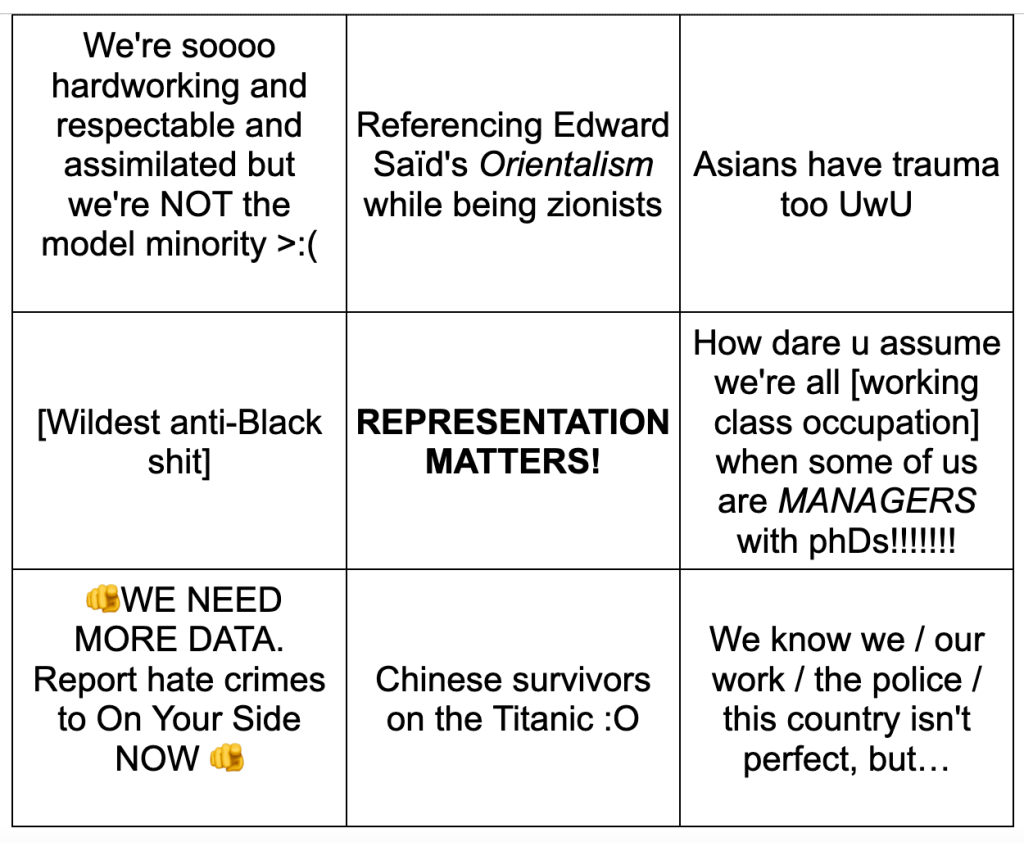
If you look at it from a certain angle, East Side Voices (2022, ed. Helena Lee) is a highly successful book. This nonfiction anthology is hyped up as the first of its kind dedicated to British East and Southeast Asian experiences. Considering that the U.K. writing scene is 94% white, this is indeed a significant intervention. The editor of East Side Voices, Helena Lee, views this book as contributing to a British ESEA consciousness, situating it in conversation with Asian American nonfiction texts. Lee also views the American context as being “a lot more politicised” as “they’ve had the Vietnam War, the Korean War, the Exclusion Acts,” as if having a series of historical events equates to doing political organising.
Another way of understanding Asian American politicisation is through Ken Chen’s tribute to the late Corky Lee, an Asian American photographer who captured the breadth of migrant organising over fifty years. Chen notes the shift away from radicalism once material conditions improved: “Today, our most notable figures are corporate CEOs and conservative politicians, the eponymous Asians rich and crazy, so the artists, revolutionaries, and workers preserved in Lee’s prints can feel as elusive as their author.” When I look at the best of Asian American cultural discourse, I see deep engagement with socio-political context and a willingness to critique. I also see the very same no exactlyyyyy conversations that plague ESEA conversations. In 2022, critic Som-Mai Nguyen asked why Asian Americans aren’t embarrassed about, among other things, a persistent false sense of cultural authority which makes the performance of IYKYK and “cloying racial cosplay” frustrating in cultural production and its surrounding discussion.
In Britain, ESEA cultural criticism is gradually developing in response to a seeming zeitgeist of cultural output. In a dissenting opinion on the so-called golden age of ESEA cinema, film critic Ian Wang points out the “stale performance of relatability, the beleaguered ‘between two cultures’ navel-gazing” in diasporic narratives. We find many of the same stock conventions in East Side Voices. I’ve been struggling to review this book since February 2023 because I don’t know if this work can fruitfully bear the weight of my critical attention. It’s clearly written for the liberal aspirational and middle class fraction of the ESEA demographic who are still new to any form of politicised collective thinking, as well as outsiders who know nothing of ESEA experiences. For example, Bidisha’s effusive 2022 review of East Side Voices notes all the contributors are successful and predictably concludes their stories show that “no amount of privilege protects you from the racism of others.” But that’s also why I think it’s time to open up a critical conversation. This book is by already-successful people, is supported by a big publisher, and has a nigh-ubiquitous presence in mainstream bookshops. And although the social category of ESEAs is marginalised and fragmented, the book does little justice to this complexity because it prioritises stories of success, assimilation and failing upwards into business ownership.
The more discerning reader is required adjust their position to understand East Side Voices‘ key perspectival trick: #representasianmatters. I have to work very hard on this for Sharlene Teo’s piece, ‘Mistaken for Strangers’. Its very title leads with the core liberal ESEA belief that racial misrecognition drives anti-Asian violence and harassment. Teo’s essay has been contextualised by the editor as “nourishing the soul a little bit when bad things happen” by “giving us vocabulary” to talk about the 8 lives lost in the 2021 Atlanta murders. This is an unnecessary burden placed upon the writing as its conception of racism – “stereotyping and socio-culturally categorising”, “microaggressions and unconscious biases”, naming “Cool” or “Nerdy” Asians à la Mean Girls – lacks explanatory power and structural attention. This is echoed in Zing Tsjeng’s essay, ‘Vector of disease’: racism is stereotypes and beliefs caused by “unconscious behaviour”.
It’s unfortunate that, of all the pieces in the book, the essays that take on the ‘big’ ESEA issues of orientalised misogyny and Covid-related racism are by authors who think that racism is misrepresentation inside the minds of disturbed individuals. Teo’s essay does not convincingly explain how and why Asian women in general are placed in danger, let alone the intersection of gender, race, class and labour that vulnerablised the Asian massage workers in Atlanta. For this, there’s decades of rigorous work by Asian organisers and scholars, such as the rapid-response statement by Red Canary Song (a collective of Asian migrant massage- and sex-workers in the ‘U.S.’) and the University of Wisconsin’s free and publicly available #AtlantaSyllabus: An Asian American Studies Perspective on Anti-Asian Violence in 2021. Rather, Teo shows what it feels like to experience orientalised misogyny when you’re a university-educated law student-turned-writer who gets harassed in public and treated as interchangeable with other Asian women in professional and romantic life. The most successful part of the essay is allowing space for aspirational and middle class Asian women to be angry. I mean this sincerely. Her essay burns brightest near the end, the material of racism cracking into sentence fragments:
Yellow fever as servile innuendo, as punchline: ironic racism is still racism. Not laughing with, laughing at. It’s not funny. Second-guessing desiribility is an aberration. An Asian fetish is more than just a harmless preference, it’s a hangover of imperialism. Deliberate other: imbalanced, sustained.
The language comes close to fizzling out with the frustration of trying to name the violence of the entire world when the only tool currently available to you is a little cartoon pain scale.
I don’t necessarily expect personal essays to feature heavy-hitting socio-political commentary. After all, this is a trade book from an imprint of a big 5, not a radical political press. But it’s worth noting this book will be read as if it’s politically radical by the more naïve reader, in part because post-covid ESEA liberalism has created a successful version of identity that’s commingled with prestigious markets as consumer-activists. To buy this book, published by a highly profitable imprint of a major publishing house, potentially becomes an example of “activism” or “solidarity” for the middle class of racially marginalised communities. This mainly benefits the publishing company as social capital is converted into book sales. Anyone searching for deeper answers will be largely frustrated.
But some of the writing in this book manages to locate politicised strength within deeply personal experience while remaining light and readable. For example, June Bellebono’s tender essay, ‘Ladyboy’, concerns their experience with indigenous Burmese trans femininity. While it was deeply affirming to experience a Nat festival with femme gay men and trans feminine spiritual mediums being adored by the crowd, Bellebono acknowledges their positionality as a Westerner:
I think my initial connection with the Nat Kadaws has slightly worn off. Our experiences, contexts and lives are wildly different. […] I’m limited in understanding their lives, and also in translating them. What is unlimited is the fluidity of my gender.
(An important note is that Bellebono recently thoughtfully wrote about their de-(re)transition.)
I would have liked to see Bellebono draw out the comparison between the Nat festival and a queer night out in terms of labour. This would have added resonance to “ladyboy” as the title and term of contention: in Thailand, ladyboys, kathoey, trans women and trans feminine people have limited employment options due to transmisogyny. According to a 2015 report by the International Labour Organization, Thai trans feminised labour in urban areas is often self-employed in the sex, entertainment, and beauty service industries, while in certain rural areas it takes the form of specific fruit-picking tasks or spiritual mediums. It makes me think of how trans feminised labour and meaningful public visibility is both different and the same in the West. What would it mean to recognise certain continuities while paying close attention to specificities?
What’s refreshing about Bellebono’s writing is how they move through these contradictions with openness and discernment, offering us ‘both/and’ as a way of thinking through the political and personal. Bellebono reflects on the tension between public visibility and personal knowledge, observing that hypervisibilisation does not solve how trans people, particularly trans women and trans feminine people, are rendered vulnerable to structural violence. Theirs is the only essay in this book that questions if visibility in public life is desirable.
In contrast, Tsjeng analyses “miniscule representation” in the ruling class as contributing to anti-Asian racism. This surface-level conception of racism means she does not adequately historicise the relationships between race, xenophobia and medicine in her essay about this very subject. “You would think that the advent of modern medicine would bury this kind of prejudice,” Tsjeng writes, after describing late 19th–early 20th century pogroms in the U.S. settler colony that targeted Asian migrant workers as disease-carriers. But the beginning of modern medicine does fall within the period she describes. Healthcare as we know it continues in service of colonial knowledge-making and upholding colonial material structures. This failure to really follow through with theoretical frameworks reminds me of Teo’s attempt to ground personal experience in a mish-mash of W.E.B. DuBois’ double-consciousness and Krafft-Ebing’s sexology. In Tsjeng’s essay, History mainly lends believable weight to her personal experience of Covid-related sinophobia, rather than historical method that could show us new insights into how and why sinophobia is reproduced. (I dread to think who’s fooled by this.)
Romalyn Ante’s essay, ‘Battle Ground,’ also looks at the initial devastation of the ongoing Covid-19 pandemic, focusing with loving pride on her mother’s tireless work as a nurse. Ante deploys military metaphors and rhythms to vividly describe this intense, precise and risky labour, blending form with subject to open a rich conversation around the social role and history of Filipino nursing. But there’s a similar historiographical issue as with Teo and Tsjeng’s essays. I’m curious about the author’s decision to gloss over the origins of medical training in the Philippines as a natural response to Japanese occupation in WWII, while the creation of an overseas healthcare workforce is reduced to merely following erstwhile American comrades for “greater opportunities” in the U.S.
Community organiser and writer Francesca Humi offers a significantly different historicisation: health education was specifically designed as a U.S. imperialist endeavour, producing a workforce destined for outward labour with the promise of self-rule through “benevolent assimilation.” Ante’s sanitisation reads as if she can’t directly address this part of a history that she otherwise so vividly describes. Indeed, she later repeats higher-paying opportunities with increasing discomfort, revealing intimate details of what it’s like to nurse the world for remittance that ensures basic resources for distant family back home. Humi notes that the cultural narrative of the “modern-day hero” who endures tremendous hardship to form the backbone of the Philippines’ economy is well-established, normalising exported labour. As there’s an asymmetric narratival void in UK mainstream media, it’s understandable that Ante writes, “Why is so very little known about our community? Especially when this country relies so heavily on us? These thoughts plague me every day.” However, the extractive, invisibilising function of the colonial metropole is not a secret. There’s intellectual work and labour organising both within and outside a Filipino context that not only answers the questions which trouble Ante, but fights for meaningful recognition that directly improves people’s material conditions.
I have so far been heavily critical about misrecognition and misrepresentation. It isn’t only because the book frequently tries to explain structural racism this way. It’s that most of the attempts to describe personal experiences of misrecognition are #relatable content rather than being well-written prose. Claire Kohda’s ‘Portraits’ is a successful example of diverging from stock convention by approaching a common experience from a uniquely horrifying angle. The essay opens with a younger Kohda’s full-body dissociation while travelling to visit her emotionally withholding white English grandparents. To make matters worse, her grandmother has painted a portrait of her with lighter eyes, hair, and blushing skin. Kohda tries to place this work in its proper art historical context alongside other artists who have depicted their family, including her father’s own portraiture. “A painting, I think, is always a labour of love,” she writes, after denying the idea that her grandmother may have deliberately created a whitened image of her.
It’s excruciating. I struggled against this, the art school pedant in me rising up with a neeky correction – Well actually, there’s online classes on painting skintone these days – but that’s not the point. Kohda musters her knowledge of art, her empathy and writing ability, into constructing her grandmother as a figure incapable of outwardly exerting violence. Nana is merely withholding: Kohda’s cousins get bags of sweets, she gets nothing. Only in the postscript does an adult Kohda apprehend that painting, and thus her grandmother, can be emotionally violent. She now has proof that her grandmother deliberately “toned down” her skin colour with a paintbrush “sharp as a knife” – painting as surgical, subtractive, bloodstained. The portrait’s “beautiful, soft English-rose blush” participates in the historical construction of whiteness, as Angela Rosenthal writes in her analysis of 18th century English portraiture: “White remains the ‘unraced’ norm […] Thus black skin, rather than red cheeks, emerge as raced.”
If a painting is a labour of love, we must ask ourselves who or what is the object of love. In Kohda’s story, it seems whiteness itself was lovingly painted – a pink-cheeked grandchild, the hope of white futurity. Unpicking the previous ending of the essay finally allows the author’s own anger to exist, reframing the beginning of the piece: we realise that her grandmother is such a negative force that anticipating her presence pushes the younger Kohda out of her own body. The strength of this essay lies in its refusal of an easy resolution.
Now, how should I end this piece of critical writing? I’ll return to Som-Mai Nguyen:
Cherishing the self-respect of ambivalence amounts to neither “gatekeeping” nor holding a “scarcity mindset.” Of course, the observation that “shallow” “representation” “fails” is by now practically its own unbearable, obvious cliché (in which I have nonetheless engaged), but I refuse to forfeit “the gift of being disgusted,” to appropriate Walter Benjamin.
I feel the urge to head off any defensiveness with my own by making it clear that I literally don’t have the power to gatekeep anything. I’m a small-time writer and artist. Worry more about pissing off some Goodreads weirdo! We must be able to treat things like this for what they are: intentionally high-profile, well-resourced projects that miss the mark exactly because of these layers of privilege. If a project like this can’t be positioned in our discourse as being able to tolerate engaged, rigorous public critique so that we all might re-engage (re-present!!) a little more deeply, then what can?
But I also see how people might think that if I have an untender opinion of this book, then it means I think problematic work deserves the same public blasting to discourage its reception – the “scarcity mindset” that Nguyen mentions. I’d like to share that I avidly support the proliferation of the ESEA cultural scene, especially independent projects. I engage with a lot of work which I think is mediocre, perhaps even actively harmful, and I carefully discuss it in private – especially if it’s clearly raw work by smaller creators and for communities which are deeply marginalised within the current ESEA context. I’m also going to reiterate I sat on this review of East Side Voices for multiple years because I wanted to see how the broader cultural landscape developed. In the meantime, I was constantly doing my own research and holding conversations with close friends and trusted people in the broader ESEA community about the critical vacuum that’s maintained here. I don’t want to just react, but really engage and share that thinking with others in order to encourage generative conversations. Don’t you want the same?
Maybe this is the thing: rather than a definitive conclusion (or, even worse, a star rating), it would be helpful to share some questions. I don’t want to authorise what’s ‘worth’ ‘consuming’ (ugh!), or give ‘constructive criticism’ that the creator literally cannot act upon and has no reason to respect my recommendation because, well, I’m not part of their creative team.
Rather, these questions should encourage everybody’s imperfect and sincere attempts to make something, anything. It shouldn’t just be stupid middle class-ish ESEAs like me who do the work of seeing. I want to see what you’re doing. Promise.
The title of Ken Chen’s essay on Corky Lee’s photography features the words, ‘the work of seeing.’
- What does ‘the work of seeing’ mean to you personally? Your friend groups? Your wider communities?
- What kinds of relationships can we create by seeing and recognising one another?
- How do we know we’re recognised by each other? Can this be documented in some way? If so, how do we do this with both care and creativity?
- Who else has done this work before us? How can we acknowledge this?
- How can we share this recognition in a way that suits our group? Who can help us do this – and what kind of relationship will we have?
- Is public sharing the only way to take up space in public discourse? (Which public, what space, which discourse?)
- How do we want outsiders to engage with our experiences? (Who is “us”, “we”, “outsider”?) What parts can we control, what parts can’t we control, and why?
- What happens when things go right? What happens when things go wrong?
- What is the process for repair, reflection, accountability and growth for inside and outside the group?
- How do we let each other know we’ve done well and want to see more of something?
- How do you decide if a project is resolved?
- What is the afterlife of a project?
 Pear Nuallak